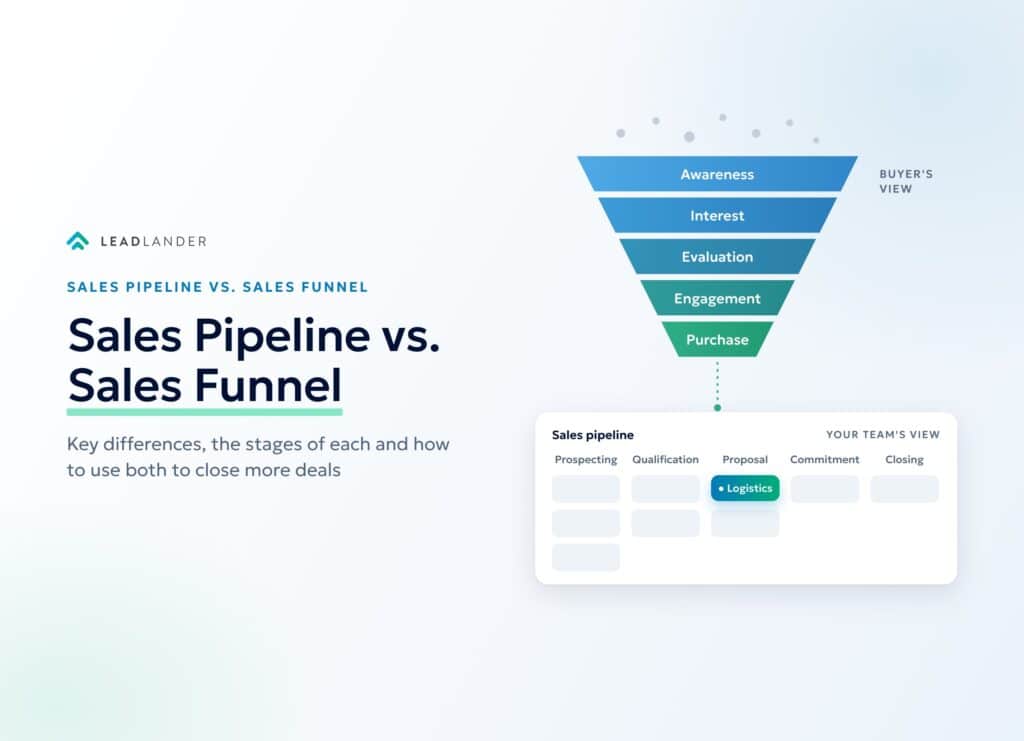
A sales pipeline and a sales funnel look at the same deals from two sides. The sales pipeline is your team’s view: every open deal and the step a rep needs to take next. The sales funnel is the buyer’s view: the path a customer takes from first hearing about you to signing. You need both, because a deal only closes when the two line up.
A lot of teams use the two terms interchangeably or blend them into one “sales pipeline funnel,” but they measure different things. Mix them up and you end up forecasting on deals that aren’t ready, or pushing buyers who are still comparing options. Let’s sort them out.
What Is a Sales Pipeline?
A sales pipeline is a visual map of every active deal and the stage it’s in, from first contact to closed. It’s built around what your sales team does, so it’s where you go to see which deals need a follow-up this week, what’s likely to close this quarter and where things keep getting stuck.
Most teams run their pipeline in a CRM like Salesforce or HubSpot, where each deal sits in a stage until a rep moves it forward.
What Is a Sales Funnel?
A sales funnel is the path a buyer takes from first noticing your company to becoming a customer. It’s built around what the buyer does: reading, comparing, asking questions and making the final call (or getting sign-off from whoever does).
It’s shaped like a funnel because the numbers shrink at every step. Plenty of companies visit your site, fewer compare you against competitors and only a handful ever talk to sales. If you’ve read our guide to the marketing funnel, this will look familiar. The difference is scope: the marketing funnel gets people interested, while the sales funnel follows them all the way to a signed contract, including every conversation with your team.
Side-by-Side Comparison
Sales Pipeline vs. Sales Funnel
How the two compare on what they track, who owns them and what to measure
Sales Pipeline | Sales Funnel | |
|---|---|---|
Point of View | Your sales team | The buyer |
What It Tracks | Deals and the actions reps take on them | Buyers and the decisions they make |
Typical Stages | Prospecting, qualification, proposal, commitment, closing | Awareness, interest, evaluation, engagement, purchase |
Question It Answers | What do we need to do next to close this deal? | Where is this buyer in their decision, and what do they need? |
Key Metrics | Pipeline value, win rate, deal velocity (how fast deals close), conversion between stages | Visitors, leads, conversion rate by stage, drop-off |
Owned By | Sales | Marketing and sales together |
Where It Lives | CRM | Website analytics, marketing automation and CRM |
Best For | Forecasting revenue and managing rep activity | Finding where buyers lose interest and fixing it |
| When It Starts | When your team makes first contact or qualifies a lead | The first time a buyer hears about you, often weeks before they contact you |
| Common Mistake | Moving deals forward before the buyer is ready, which inflates the forecast | Losing buyers who research quietly and leave without filling out a form |
| How to Fix It | Set entry rules so a deal only moves when the buyer takes action, like booking a demo or asking for pricing | Identify the companies visiting your site so you can reach out before they choose someone else |
In other words, the funnel follows the buyer, and the pipeline follows your team’s work to win them over.
The 5 Stages of a Sales Pipeline
- Prospecting. Find companies that look like your best customers (your ideal customer profile).
- Qualification. Confirm they have a real need, budget and timeline, and figure out who makes the call.
- Proposal. Present your solution, pricing or demo, tailored to what they care about.
- Commitment. Work through objections, negotiate terms and get a verbal yes.
- Closing. Won deals go to account management. Lost deals go back into nurturing, because “not now” isn’t “never.”
When every rep uses the same stages, your forecast stops being a guess. To keep those stages honest, learn how to run a sales pipeline meeting that keeps deals moving.
The 5 Stages of a Sales Funnel
- Awareness. The buyer has a problem and finds you through search, a referral, an ad or a social post.
- Interest. They dig in: your blog, services page and case studies.
- Evaluation. They compare you with alternatives. Pricing page visits pick up here.
- Engagement. They talk to your team, ask questions and bring in colleagues.
- Purchase. They sign. Now the goal is keeping them happy enough to renew and refer.
Engagement is where a lot of sales teams trip up. Just because a buyer is talking to you doesn’t mean they’re ready to sign, and if you push too early, they go quiet. Knowing the stage also tells you what to send. A buyer still in evaluation will get more out of a case study than a contract.
Pipeline Meets Funnel
How the Sales Pipeline and Sales Funnel Work Together
Every time a buyer moves forward in the funnel, the deal should move forward in your pipeline too. If one gets ahead of the other, deals stall. Here’s how the stages line up:
| Buyer’s Funnel Stage | Matching Pipeline Stage | What Your Team Does |
|---|---|---|
Awareness | Prospecting | Spot companies that look like your best customers |
Interest | Qualification | Confirm need, budget, timing and who’s involved |
Evaluation | Proposal | Share pricing, a demo or a tailored plan |
Engagement | Commitment | Answer objections, loop in decision-makers and negotiate |
| Purchase | Closing | Sign, hand off to account management or nurture if lost |
Here’s a Sales Pipeline vs. Sales Funnel Example
Say you sell managed IT services to mid-sized companies. Here’s how a deal with a 200-person logistics company plays out in each view.
- Week 1: Their operations director searches “managed IT for logistics companies” and reads two of your blog posts. Funnel: awareness, then interest. Pipeline: nothing. Your team doesn’t know they exist.
- Week 2: Three people from the company visit your pricing page and a case study. Funnel: evaluation. Pipeline: still nothing.
- Week 3: The operations director books a call. Funnel: engagement. Pipeline: the deal finally shows up, at qualification.
- Week 6: Proposal sent, terms agreed, contract signed. Funnel: purchase. Pipeline: closed won.
By the time the deal showed up in your pipeline, the buyer had already spent two weeks researching, and probably talking to your competitors too.
Curious which companies are already researching you? Try LeadLander for free.
How to Use Your Sales Pipeline and Sales Funnel to Close More Deals
- Map your stages. Line up funnel stages with pipeline stages using the table above, and agree on the definitions with marketing.
- Set entry rules for each pipeline stage. A deal moves when the buyer does something (books a demo, requests pricing), not when a rep has a good feeling.
- Track conversion in both. If buyers drop out of the funnel, look at your content and messaging. If deals stall in the pipeline, look at your sales process.
- Close the gap at the top. Plenty of buyers do their research before they ever fill out a form. If you can see who they are, you can start the conversation sooner.
- Review both every month. Look at where buyers drop off and where deals stall, fix one thing and check again next month. Find the top 13 sales tracking templates here.
Fill Your Pipeline With Buyers Already in Your Funnel
Remember that logistics company? It spent two weeks on your site before anyone on your team knew it existed. That happens every week. Buyers in the middle of your funnel are reading your services page and comparing your pricing, and none of them show up in your pipeline until they fill out a form.
You can’t make every buyer fill out a form, but you can see who’s already looking. That’s the idea behind LeadLander. It shows you which companies are visiting your site, the individual visitor when available, what they’ve read and whether they’ve been here before. If a target account comes back, you get an alert, so you can reach out while they’re still deciding. And because you know what caught their interest, your first email can speak to it.
Getting started takes one small piece of code, and LeadLander connects to Salesforce, HubSpot and Slack, so new leads show up where your team already works.
Try LeadLander free with full access for 14 days, and keep every lead you find.
Common Questions
Frequently Asked Questions
Short answers on stages, metrics and how the two fit together.
A sales pipeline tracks the deals your sales team is working and the next step for each one. A sales funnel tracks the buyer’s journey from first awareness to purchase.
Not quite. A marketing funnel focuses on getting people aware and interested until they’re ready to talk to sales. A sales funnel covers the full path to purchase, including the sales conversations. Read more in our marketing funnel guide.
The sales funnel usually comes first. Buyers start researching before your team knows they exist, and a deal only enters your pipeline once you can identify and qualify them. Website visitor identification helps you spot them sooner.
Most sales pipelines have five to seven stages. A common setup is prospecting, qualification, proposal, commitment and closing. The right number is whatever matches the real steps your buyers take.
In your pipeline, track pipeline value, win rate, deal velocity (how fast deals close) and conversion between stages. In your funnel, track visitors, leads, conversion rate by stage and where buyers drop off.
You can, but it won’t stay full for long. Without a funnel feeding it, your pipeline depends on cold outreach alone, and you miss the buyers who are already researching you.