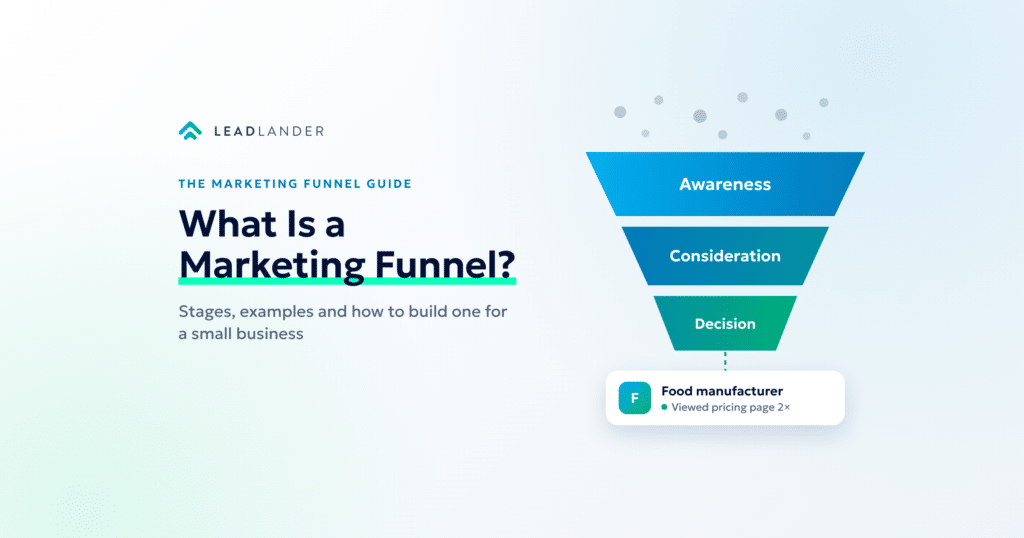
A marketing funnel is the path people take from first hearing about your business to becoming a paying customer. It’s shaped like a funnel because lots of people enter at the top and fewer make it through each step. Most funnels have three stages: awareness, consideration and decision.
If you run a small business that sells to other businesses, such as a packaging supplier, a machine shop, an IT provider or an accounting firm, you already have a marketing funnel, even if you’ve never drawn one. Every client found you somehow, learned enough to trust you and decided to hire you. This guide explains each stage in plain terms, walks through an example, and shows how to build and measure a simple funnel without a big team or budget.
In this guide:
- What is a marketing funnel?
- The 3 stages of the marketing funnel
- A marketing funnel example: a small packaging company wins a new client
- How to build a marketing funnel for a small business in 5 steps
- How to measure your marketing funnel
- The funnel’s biggest blind spot: anonymous visitors
- Marketing funnel FAQs
What is a marketing funnel?
A marketing funnel is a simple model of how potential clients find your business, compare you with other options and decide to hire you. In practice, that might mean 500 people read your blog in a month, 40 come back to look at your services and 5 ask for a quote.
That drop-off is normal. A funnel shows you where people stall and which prospects are getting closer, so you can spend your time and budget on them.
You may also hear about the AIDA model or HubSpot’s flywheel. Both describe the same journey in different ways. This guide uses the three-stage funnel because it’s the simplest to put into practice.
Marketing funnel vs. sales funnel
The terms are often used to mean the same thing. Strictly speaking, the marketing funnel covers getting noticed and building interest, and the sales funnel covers the conversations, quotes and follow-ups that close the deal. In a small business, the same person often handles both, so it’s simplest to treat them as one path.
The 3 stages of the marketing funnel
Each stage has a different client mindset, needs different content and shows up differently on your website. Marketers often shorten the stages to TOFU, MOFU and BOFU (top, middle and bottom of the funnel).
| Stage | What the client is thinking | What to give them | What it looks like on your website |
| Awareness (top of the funnel) | “I have a problem. What’s causing it?” | Helpful content with no sales pitch: blog posts, short videos, social posts | A first visit, usually to a blog post from Google, an AI tool or social media |
| Consideration (middle of the funnel) | “Who could help me with this?” | Proof of results: case studies, client reviews, before-and-after numbers, an email newsletter | Return visits to your services, case study or about pages |
| Decision (bottom of the funnel) | “Is this the right choice?” | A clear reason to act: pricing, a free consultation or quote, an easy way to get in touch | Visits to your pricing, quote or contact pages |
For more on reading these signals, see Mapping the B2B Buyer’s Journey with Website Analytics.
1. Awareness (top of the funnel)
Prospects at this stage aren’t shopping yet. They’ve noticed a problem and want to understand it, so they search Google or ask an AI assistant. More and more of them read an AI-generated summary before visiting any website, which rewards content that answers questions clearly enough to be quoted.
Skip the sales pitch and teach instead. The content that works best is free to read, asks for nothing and answers the questions clients already ask you. You don’t need a big budget for it. Focus on three things:
- Know who you’re writing for. Note who your best clients are, what problem brought them to you and how they described it.
- Use their words. Free tools like Google Search Console and Google’s search suggestions show the phrases people actually type. Write for those, not industry jargon.
- Show up locally. If most of your clients are nearby, keep your Google Business Profile complete and write about the problems local clients face, such as “contract packaging in Charlotte.”
2. Consideration (middle of the funnel)
Now the prospect knows what they need and is comparing options. Your job is to earn their trust.
The most persuasive content at this stage is proof of results. That could be a case study, a before-and-after number such as a shorter lead time or a lower cost per unit, or a review from a client in the same industry.
Email keeps you in mind while prospects decide. One simple guideline, borrowed from social media planning, is the 4-1-1 ratio. For every six emails, send four helpful ones, one soft promotion such as an event invite and one direct offer. Set them up as an automated drip campaign so they go out on schedule. Website visit data can also help you tailor those emails; see Mastering B2B Personalization with Website Visitor Tracking Data.
3. Decision (bottom of the funnel)
The prospect has a shortlist and is close to choosing. Anything confusing or slow gives a competitor an opening.
Show pricing, or at least a starting price. Offer a free consultation or quote. Put client results near your contact button. Make the next step obvious, with one clear button such as “Request a quote” instead of several competing ones.
A marketing funnel example: a small packaging company wins a new client
Here’s how the stages play out for a hypothetical 12-person custom packaging company. The prospect is the purchasing manager at a 150-person food manufacturer whose current supplier keeps missing deadlines.
- Week 1, awareness. She searches “how to shorten packaging lead times” and reads the packaging company’s blog post on common causes of delays. A colleague in operations reads a post about recyclable packaging materials the same week.
- Week 2, consideration. She comes back to read a case study about another food brand the company works with, then checks the capabilities page to confirm it can handle her volumes.
- Week 3, decision. She views the pricing page twice. Her plant manager looks at the capabilities page the next day. She submits a quote request.
Only the quote request shows up as a lead. The owner has no idea the manufacturer’s weeks of research, or that three people were involved. Had the owner known, a short, helpful email in week two could have started the conversation while the manufacturer was still deciding who to call.
Want to know which companies are researching you right now? Get a free demo to see how website visits show up as named companies.
How to build a marketing funnel for a small business in 5 steps
Most small businesses already have the pieces of a funnel: a website, a few client results, maybe a newsletter. Building one means connecting those pieces so every visitor has a clear next step.
- Define your ideal client. Pick the type of business that brings you your best work. Write down their industry and size, who makes the buying decision, the problem that usually brings them to you and the words they use to describe it. Everything else in your funnel is written for this client.
- Create one piece of content for each stage. One per stage is enough to start:
- Awareness: a blog post answering a question clients often ask, such as “What affects the cost of custom packaging?”
- Consideration: a short case study with a before-and-after result for a similar client.
- Decision: a services or pricing page with a clear way to request a quote or book a call.
- Give every page a next step. End the blog post with a link to the case study, and end the case study with a link to pricing or a “Request a quote” button. No page should be a dead end.
- Stay in touch with visitors who aren’t ready yet. Most people won’t contact you on their first visit. Offer a newsletter signup or a free checklist, and send a short series of helpful emails to everyone who signs up. A website visitor identification tool can also show which companies visited, so you can follow up with the ones that fit your ideal client.
- Review your numbers monthly. Use the metrics in the next section to find the stage that loses the most people, and fix that one first.
How to measure your marketing funnel
Free tools like Google Analytics cover most of what you need. Start with these:
| Stage | What to track |
| Awareness | Website visitors, new visitors, how people found you (search, Google Business Profile, referrals) |
| Consideration | Return visitors, email signups, views of your case study and services pages |
| Decision | Quote and contact requests, calls booked, how many become paying clients |
The most useful number is how many people move from one stage to the next. Each drop-off points to a different fix:
- Lots of visitors, few come back. Your content attracts readers but gives them no reason to return. Add an email signup and link to related posts and services.
- Return visitors, but few inquiries. Prospects are interested but not convinced. Add case studies, client results and clear pricing.
- Plenty of inquiries, few new clients. Check how quickly you follow up and whether the inquiries fit your ideal client.
The funnel’s biggest blind spot: anonymous visitors
Every number in the table above has the same gap. It tells you how many people visited, but not who they were.
Most visitors leave without filling out a form or calling. Some are just browsing. Others are exactly the clients you want, comparing you with other suppliers before they decide. If they never reach out, you never learn they were interested, and the work may go to whichever supplier contacts them first.
For a small business, each missed opportunity costs more. You don’t have a steady stream of leads to make up for the ones that slip away, so knowing who is already interested lets you spend your limited time on the prospects most likely to hire you.
In the packaging example, the manufacturer’s two weeks of research would appear in Google Analytics as a handful of anonymous page views. The owner would only learn about the opportunity when the quote request arrived, if it arrived at all.
LeadLander closes that gap for businesses that sell to other businesses. It identifies the companies visiting your website, finds contacts at those companies and shows which pages they viewed and when. You could see that a food manufacturer read your blog, came back for a case study and checked your pricing page, then reach out while they’re still deciding. For more on acting on those signals, see How to Shorten the B2B Sales Cycle with LeadLander’s Insights. More than 1,000 companies use LeadLander to see who is visiting their website.
See which companies are visiting your website. Start your 14-day free trial with your own website traffic, or get a free demo first. Help with setup is included.
Marketing funnel FAQs
Why is having a marketing funnel important for a small business?
A marketing funnel helps a small business focus limited time and budget on the prospects most likely to hire you. It shows where prospects come from, where they lose interest and what convinces them, so you can cut spending that isn’t working and fix the stage where you lose the most people. For a small team, that focus is worth more than a bigger audience.
What is the AIDA model in marketing?
The AIDA model describes four steps a buyer moves through before acting: Attention, Interest, Desire and Action. Marketing first earns attention, then builds interest by showing how a product solves a problem, creates desire by showing why it’s the better choice, and finally prompts action with a clear call to action. The model is usually credited to advertising pioneer E. St. Elmo Lewis in the late 1890s and is often described as the earliest version of the marketing funnel.
Find out who’s already in your funnel. LeadLander shows which companies are visiting your website and which pages they view, so you can follow up before they choose another supplier. Start a 14-day free trial with your own website traffic. Help with setup is included.