In this blog: LeadLander is the better fit for most North American B2B teams that want to see who’s visiting and reach out fast, while Leadfeeder suits Europe-focused teams that want a free plan and European data storage.
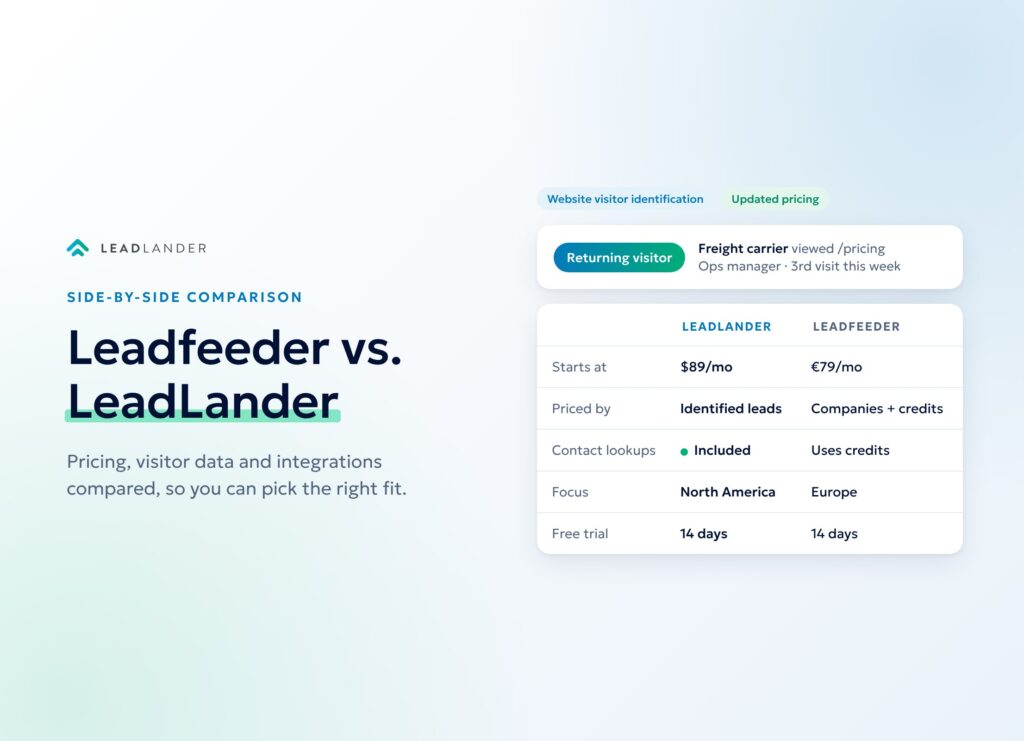
- LeadLander starts at $89 a month with no credit system, while Leadfeeder starts at €79 a month and charges credits for contact details and CRM syncs.
- Both offer a 14-day free trial and unlimited users.
- Leadfeeder is still sold as Leadfeeder, now as a product of Dealfront Group.
Leadfeeder and LeadLander both show you which companies are visiting your website, but they price and package that data differently.
LeadLander is website visitor identification software that shows which companies are on your site in real time, with published plans starting at $89 a month and unlimited users on every plan. Leadfeeder is a B2B website visitor identification tool from Dealfront Group that identifies visiting companies, with a free plan and paid plans starting at €79 a month plus a monthly pool of credits for contact data and CRM syncs.
LeadLander pulls ahead on what you can do with each visit. You see the individual visitor when available, and contacts come from a network of more than 265 million verified contacts and companies. Looking them up or sending them to your CRM doesn’t cost extra.
Which Is Better, Leadfeeder or LeadLander?
For most North American B2B teams, LeadLander is the better choice. You get a clearer picture of each visit, simple pricing based on identified leads and direct connections to Salesforce, HubSpot, Slack, Marketo, Apollo.io and OpenAI. Leadfeeder is worth a look if your buyers are mostly in Europe, you want a free plan to start or you need a direct Pipedrive, Zoho or Microsoft Teams integration.
Choose LeadLander if:
- You want to see the company, the individual visitor when available and whether they’re new or coming back.
- You’d rather pay for identified leads than keep track of a credit balance.
- You want 12 months of stored visit data on every plan.
- Your team works in Salesforce, HubSpot, Marketo or Slack and wants new leads sent there automatically.
- Most of your customers are in North America.
Leadfeeder may fit better if:
- Most of your buyers are in Europe and you want your data stored in Europe.
- You want a free plan (Leadfeeder Lite shows up to 100 companies from the last 7 days).
- You need a direct Pipedrive, Zoho, webCRM or Microsoft Teams integration.
- You expect to identify thousands of companies a month and only need contact details for a few of them.
What Is LeadLander?
LeadLander is website visitor identification software that turns anonymous website traffic into named companies and contacts your team can reach out to. You add one small piece of code to your site, and LeadLander shows who’s visiting in real time: the company, the individual visitor when available and whether they’re new or coming back. You see every page they viewed and how they found you, and you get an alert when a target account returns. LeadLander is GDPR compliant.
More than 1,000 companies use LeadLander. It connects directly to your CRM and sales tools, including Salesforce, HubSpot, Marketo, Mailchimp, Slack, Apollo.io and OpenAI, and links to other apps through Zapier or a REST API. See how LeadLander identifies website visitors for a full walkthrough.
What Is Leadfeeder?
Leadfeeder is a B2B website visitor identification tool that shows which companies visit your website, even if they never fill out a form. It filters out internet providers, adds intent data (clues that a company may be getting ready to buy) and company details. It uses credits, a monthly allowance that comes with each plan, to unlock contact information or send companies to your CRM. Leadfeeder is built on GDPR and European data protection principles and offers European data storage. Leadfeeder merged with Echobot in 2022 to form Dealfront, and it’s still sold under the Leadfeeder name as a product of Dealfront Group GmbH.
| LeadLander | Leadfeeder | |
What It Identifies | The company, the individual visitor when available and whether they’re new or returning included in every plan | The company behind the visit, plus contacts you unlock with credits |
| Data Checks | Filters out internet providers and double-checks matches against public databases | Filters out internet providers and low-quality traffic |
GDPR | GDPR compliant | GDPR compliant, with European data storage options |
Contact Data | Contact network of 265M+ verified contacts and companies, plus Apollo.io lookups included with your subscription | Contact details paid for in credits (0.2 credits for an email, 1 credit for email plus phone) |
Pricing Model | Published tiers based on identified leads per month | Published tiers based on identified companies per month plus a monthly credit pool |
Starting Price | $89/month or $900/year | Free (Lite), then €79/month (Discover) |
Billing | Monthly or annual (save 17% annually) | Monthly by card or annual upfront (30% off monthly price) |
Free Plan | No, 14-day free trial | Yes, up to 100 companies from the last 7 days |
Free Trial | 14 days, and you keep every lead you find | 14 days, then moves to the free plan |
Users | Unlimited on every plan | Unlimited on every plan |
Stored Data | 12 months on every plan | 7 days on the free plan; paid plans not stated on its pricing page |
Direct CRM Integrations | Salesforce, HubSpot | Salesforce, HubSpot, Pipedrive, Zoho, webCRM, Microsoft Dynamics |
Other Integrations | Marketo, Mailchimp, Slack, Apollo.io, OpenAI, Zapier | Slack, Microsoft Teams, Google Ads, LinkedIn |
API | REST API (included on Enterprise) | Not listed on its pricing page |
CRM Sync Cost | Included | 1 credit per company exported or synced |
Regional Focus | North America | Europe, with data partnerships covering North America |
Best For | North American B2B teams that want visitor-level detail and simple pricing | Europe-focused teams that want a free plan and European data storage |
How Leadfeeder and LeadLander compare on pricing, visitor data, integrations and trials.The biggest difference is what you pay for. Leadfeeder’s entry price is lower, but every contact you pull or company you send to your CRM draws from your monthly credits. With LeadLander, those steps are part of the plan, so following up on more leads doesn’t add to your bill.
How Leadfeeder and LeadLander Identify Website Visitors
Both tools match the IP address behind each visit to a business and filter out internet service providers, so you aren’t chasing a cable company. LeadLander also double-checks its matches against public databases and shows the individual visitor when available. Company details, page activity and contacts sit together in one place, so your reps can go from spotting a visit to sending an email without digging through other tools.
Leadfeeder identifies the company and shows which pages it viewed. To see contacts at that company, you spend credits from your monthly allowance. Leadfeeder says its data favors accuracy over volume and that match rates can be lower in smaller markets.
No visitor identification tool matches every visit, since people browse from home networks, phones and VPNs. The best way to judge either tool is on your own traffic, and both offer a 14-day free trial. (For more on getting value from that data, see these website visitor tracking best practices.)
Leadfeeder vs. LeadLander Pricing
Leadfeeder pricing and LeadLander pricing, plan by plan. LeadLander lists three plans on its pricing page. Pricing is based on identified visitors, and every plan includes unlimited users and 12 months of stored data. Paying annually saves 17%.
| LeadLander Plan | Monthly | Annual | Identified Leads | Also Included |
|---|---|---|---|---|
| Starter | $89 | $900 | Up to 100 per month | One domain, access to contact network |
| Growth | $259 | $2,568 | Up to 2,000 per month | Onboarding, ongoing training, dedicated account support |
| Enterprise | Custom | Custom | Unlimited | Unlimited domains, API access, dedicated account manager, email, phone and chat support |
Leadfeeder lists five plans in its pricing help article. Prices are shown in euros or US dollars depending on where your company is, and annual plans are paid upfront at 30% off the monthly price.
Leadfeeder Plan | Starting Price | Companies Identified | Credits per Month |
|---|---|---|---|
| Lite | Free | Up to 100 (last 7 days only) | Pay per Action |
| Discover | €79/month | Up to 1,000 per month | 50 |
| Activate | €369/month | Up to 4,000 per month | 200 |
| Scale | €599/month | Up to 10,000 per month | 1,000 |
| Enterprise | Custom | Custom | Custom |
Leadfeeder’s entry plan covers more companies for the money. The real cost depends on how many of those companies you follow up on. On Discover, 50 credits covers 50 contacts with email and phone, or 50 companies sent to your CRM. If your team follows up on most of the companies it sees, LeadLander’s pricing is easier to predict and easier to get approved (or to explain to whoever signs off on the budget).
Leadfeeder and LeadLander Integrations
With LeadLander, your reps see new companies, contacts and visits in Salesforce or HubSpot without typing anything in. A Slack alert tells them when an important company lands on a key page, so they can follow up while the visit is still fresh, and Marketo and Mailchimp give marketing the same data. The Apollo.io integration helps you find the right person at a visiting company by searching for job titles, and OpenAI gives you a first draft of an email based on what that company read. Anything else your team uses can connect through Zapier, or your developers can build their own connection with the REST API.
Leadfeeder connects directly to more CRMs, including Pipedrive, Zoho, webCRM and Microsoft Dynamics, so it’s the easier fit if your team works in one of those. It sends alerts to Slack or Microsoft Teams and connects to Google Ads and LinkedIn. Keep in mind that each company you send to a CRM uses a credit.
A Leadfeeder vs. LeadLander Example: A Logistics Software Company Tests Both
Say you run marketing for a 40-person logistics software company in Chicago. Most of your buyers are in the US and Canada, and your sales team works in HubSpot. You start both 14-day trials on the same Monday.
- Week 1: Both tools start naming companies. In LeadLander, you see that a regional freight carrier has visited your route-planning page three times, along with the operations manager who’s been reading it. In Leadfeeder, the same carrier shows up as a company, and you spend a credit to pull a contact.
- Week 2: You add the carrier to a LeadLander watchlist with a Slack alert. On Wednesday it comes back and heads to your pricing page. Your rep gets the alert, sees which pages they read and sends a note about route planning that afternoon. The lead is already in HubSpot.
- Week 3: Your trials end. Leadfeeder moves you to its free plan, and you’re working out how many credits your team would use each month. With LeadLander, your rep is already talking with the freight carrier, and your price didn’t change no matter how many contacts you looked up.
Curious which companies are already researching you? Book a live demo and we’ll show you.
How to Choose a Website Visitor Identification Tool in 5 Steps
Five steps to compare Leadfeeder, LeadLander or any website visitor identification software.
- Decide what you’ll do with the data. Know whether leads go to sales reps, a marketing nurture or both before you compare features.
- Estimate how many companies you’ll act on. If you follow up on most of them, add the cost of contact lookups and CRM syncs to the base price.
- Run both trials on your own traffic. Check the results against current customers and open deals to judge accuracy.
- Test the integration your team uses every day. Send a few leads into your CRM or Slack and make sure they show up where your team works.
- Get the full price in writing. Ask about monthly vs. annual billing, lead or credit limits and what happens at renewal.
See Which Companies Are Already on Your Website
Remember that logistics software company? The freight carrier read the route-planning page three times and never filled out a form, and most buyers don’t. You can’t make every buyer fill out a form, but you can see who’s already looking. That’s the idea behind LeadLander.
With LeadLander, you see which companies are on your site as it happens, who’s visiting when that’s available and whether they’ve been here before. You can see the pages they read, so your first email speaks to what they care about. Getting started takes one small piece of code, and new leads can flow into Salesforce, HubSpot or Slack from day one.
Try LeadLander free with full access for 14 days, and keep every lead you find.
Frequently Asked Questions
Leadfeeder vs. LeadLander FAQ
Answers to the questions buyers ask most about Leadfeeder and LeadLander pricing, trials and data.
LeadLander charges for identified leads and includes contact lookups and CRM syncs, while Leadfeeder charges for identified companies and uses credits for contact data and CRM syncs. LeadLander also shows the individual visitor when available and focuses on North America. Leadfeeder has a free plan, more direct CRM integrations and European data storage. Both tools are GDPR compliant.
Leadfeeder is still sold as Leadfeeder, now as a product of Dealfront Group GmbH. Leadfeeder merged with Echobot in 2022 to form Dealfront, but Leadfeeder’s website visitor tracking has its own site, plans and pricing at leadfeeder.com.
Leadfeeder has a free Lite plan and paid plans starting at €79 a month for up to 1,000 identified companies and 50 credits. Activate starts at €369 a month and Scale at €599 a month, and annual billing is 30% off when paid upfront.
LeadLander starts at $89 a month, or $900 a year, for the Starter plan with up to 100 identified leads per month. The Growth plan is $259 a month for up to 2,000 identified leads, and Enterprise pricing is custom. Every plan includes unlimited users and 12 months of stored data.
Yes, Leadfeeder Lite is free and shows up to 100 identified companies from the last 7 days. LeadLander doesn’t have a free plan, but its 14-day free trial includes full access and you keep every lead you find.
LeadLander is a popular Leadfeeder alternative for North American teams that want visitor-level detail and pricing without credits. Lead Forensics is another option; see our LeadLander vs. Lead Forensics comparison for how it stacks up.